When we think of a laboratory shaker, it is easy to imagine a simple device that makes containers move back and forth.
But shaking is not simply about “shaking.”
In many laboratory workflows, controlled motion plays an important role in culturing, extraction, and mixing. The goal is to keep samples moving, improve contact between components, and promote more uniform conditions throughout the process.
What Does a Laboratory Shaker Actually Do?
At its core, a shaker creates continuous, controlled movement.
This movement can help:
- Keep liquid samples in motion
- Increase contact between liquids, cells, or solid materials
- Improve mixing uniformity
- Support aeration and mass transfer
- Promote more consistent experimental conditions
The exact effect depends on the sample, container, and shaking parameters.
One Principle, Different Applications
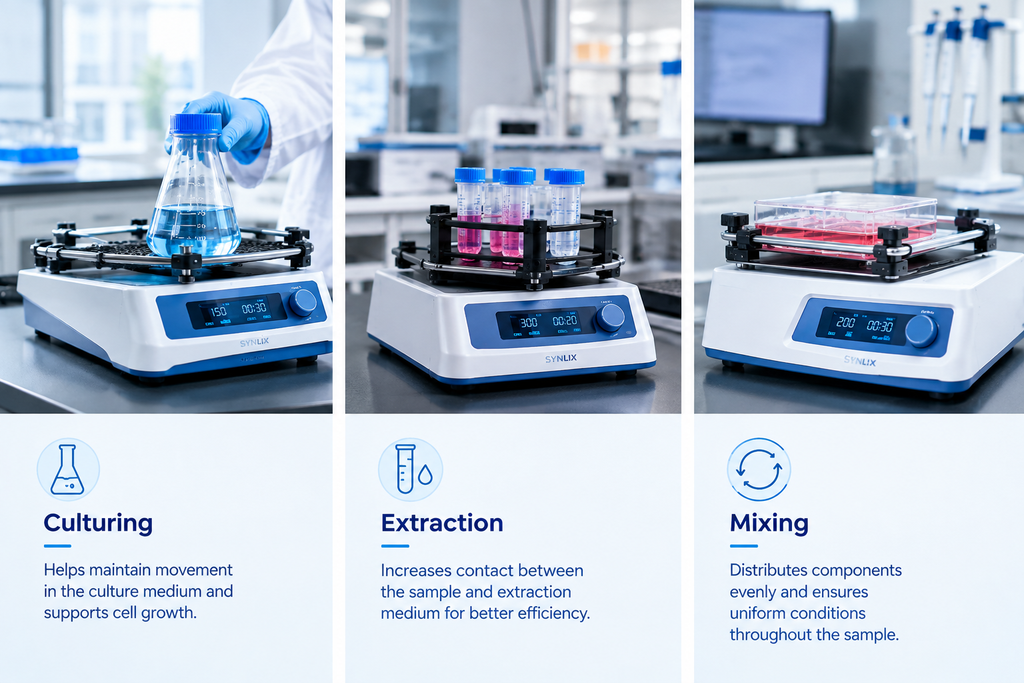
1. Culturing
In cell or microbial culture applications, controlled shaking can help maintain movement within the culture medium and improve contact between the sample and the surrounding environment.
The appropriate shaking conditions depend on the culture type, vessel, and experimental requirements.
2. Extraction
For extraction applications, movement helps increase contact between the sample and the extraction medium.
Continuous shaking can promote more uniform interaction and improve the efficiency and consistency of the extraction process.
3. Mixing
For routine laboratory mixing, shaking helps distribute components more evenly throughout a sample.
Different shaking motions and speeds can be selected depending on whether the application requires gentle movement or more intensive mixing.
Three Parameters to Consider When Choosing a Shaker
Choosing a shaker is not simply about finding the model with the highest speed.
Three parameters are particularly important:
Speed — How Fast?
Speed refers to how quickly the platform moves, usually expressed in rpm (revolutions per minute).
Higher speed generally produces more intensive movement, while lower speeds are suitable for gentler applications.
Orbit / Amplitude — How Far?
The orbit or amplitude describes the size of the movement.
A smaller movement can provide gentler agitation, while a larger movement creates a wider motion.
The right choice depends on the sample, vessel, and application.
Temperature — At What Condition?
Some shaking processes are sensitive to temperature.
For these applications, the shaker may need to operate inside an environmental chamber or CO₂ incubator, or be combined with temperature control.
Temperature stability can be just as important as shaking performance when working with biological samples.
The Right Shaker Depends on the Application
There is no single “best” shaker for every laboratory.
Before choosing a model, consider:
What are you shaking?
Cells, culture media, chemicals, extraction samples, or other materials?
What vessel are you using?
Flasks, beakers, culture dishes, tubes, or other containers?
How much movement is needed?
Gentle motion or more intensive mixing?
Does temperature matter?
Will the shaker operate under controlled-temperature conditions?
The right combination of speed, orbit/amplitude, capacity, and operating environment can make a significant difference in laboratory workflows.
Final Takeaway
A laboratory shaker is more than a machine that makes samples “shake.”
It is a tool for creating controlled movement — helping improve contact, uniformity, aeration, and consistency across different laboratory processes.
Instead of asking only:
“How fast can it shake?”
Ask:
“What kind of movement does my application actually need?”
That is the starting point for choosing the right laboratory shaker.